
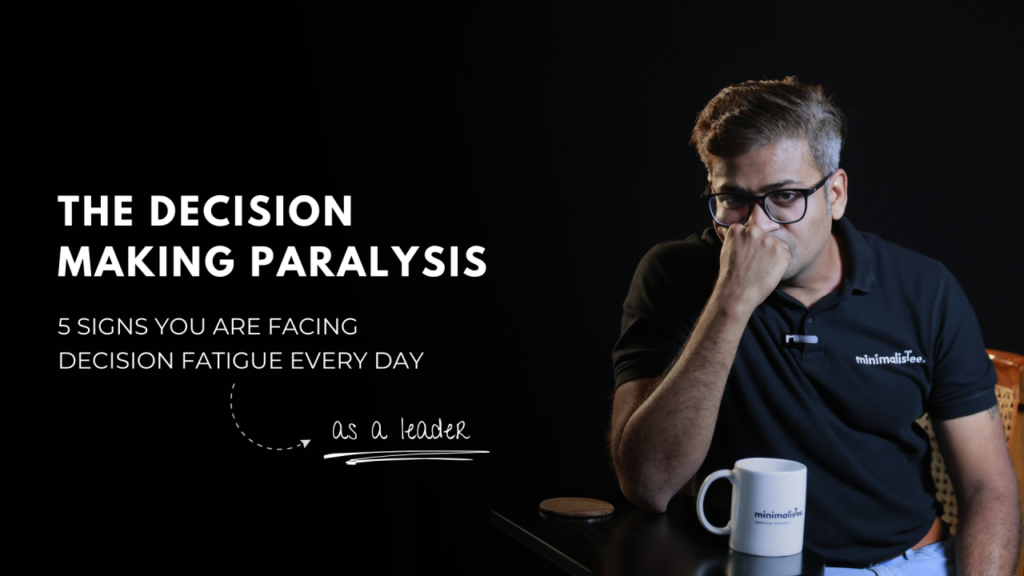
5 Signs You Are Facing Decision Fatigue Every Day As A Leader
“You’ll see I only wear grey or blue suits. I’m trying to pare down decisions. I don’t want to make decisions about what I’m eating or wearing. Because I have too many other decisions to make.” – Barack Obama
Are the choices you make every day truly your own?
Or are they simply echos of an exhausted mind that has stopped thinking clearly?
Most of us are aware of that 4 PM feeling. The one where your inbox is overflowing, 3 people are waiting for your call, and someone just asked if you prefer the blue deck or the green one – and suddenly, you can’t remember why any of it matters.
You say “yes” when you meant “let me think.” You postpone the conversation you know you need to have. You snap at someone who didn’t deserve it. Then you drive home replaying the moment, wondering why you couldn’t just stay steady. Is is one bad day? Or are you overwhelmed with daily decisions?
60% of executives experience impaired judgement after prolonged decision-making sessions, leading to errors in strategy and communication, according to a 2023 University of Cambridge study. We’re built to decide fast and execute relentlessly. But that same strength becomes our vulnerability when we don’t recognize the cost.
Every meeting you take, every message you answer, every “quick question” from your team – it all drains from your limited daily decision making capability. And when it runs dry, you start making choices on autopilot, to just get it done.
Let us share with you 5 signs that you are facing decision making paralysis every day due to fatigue.
1. Re-Deciding What You’ve Already Decided
As leaders scaling a business, a lot of our days look identical. That pricing question? You answered it last month. The vendor approval? Third time this quarter. Client onboarding confusion? You’ve walked someone through it again.
There is a missing system to avoid such repeated decisions. Hence it comes to you every single time. Things would probably still be simple if these choices didn’t come with huge consequences. But, we are blessed with opportunities to say, they do. Our choices decide people’s days, paychecks, reputations, and futures. That’s what makes this so crucial. Every time you solve it again instead of systematizing it, you’re choosing today’s relief over tomorrow’s freedom.
2. The Best Hours Are Spent Firefighting
The day starts with you trying to solve the issues of the day. Someone needs an urgent answer, client calls, etc. And just like that, your most productive hours are gone. There are limited number of clear decisions we can make in a day and best ones gets used to fix yesterday instead of building tomorrow.
Your mornings become chaotic sessions because operational ownership isn’t airtight. Instead of protecting strategic bandwidth, the system defaults to founder resolution. When your most cognitively valuable hours get spent stabilising execution, it is an operational design problem.
3. Teams Can’t Move Without Your Approval
You built processes. You have SOPs. But somewhere along the way, they got so layered, so conditional, so unclear – that it leads to decision paralysis, not clarity. When edge cases appear, people hesitate because guiding principles aren’t simple. There are too many exceptions. Too many layers. Too much interpretation required.
Hence they default to the safest move: asking you. You end up exhausted from deciding things people should be able to handle. And they are frustrated waiting on you for things they wish they could just do. Everyone’s stuck. Nobody wins.
4. Your strategic priorities don’t eliminate enough
Quarterly goals exist. OKRs might be defined. But we are in speed driven industries. Any new opportunity comes in or potential partnership, instead of measuring it against the set goals for the year, 10 new things are added in addition to existing ones.
If new initiatives keep entering mid-cycle, it means strategic filters are not strong enough. There is no explicit “not now” list. No capacity planning discipline. No clear trade-off rule that says adding one initiative requires removing another. As leaders scaling a business, a lot of us see possibility in everything. That’s the gift. But it’s also the trap.
5. Giving Equal Energy to Unequal Returns
There’s a well-known idea across business philosophies called the Pareto Principle, often explained as the 80/20 rule – roughly 20% of your efforts create 80% of your results. In most businesses, a small set of clear decisions drive most of the revenue.
Yet daily energy rarely reflects this reality. Attention gets divided almost evenly. Urgent requests override important ones. High-maintenance clients consume senior bandwidth. Low-impact tasks stay alive because they feel necessary in the moment.
When there is no structured review of where time and energy are actually generating leverage, effort spreads thin. And when effort spreads thin across unequal returns, leaders feel tired while growth feels slower than it should.
That misalignment is where decision fatigue compounds.
Somewhere along the way, we start measuring ourselves by how much we’re handling.
If you feel tired, you assume you are not strong enough. If decisions feel heavy, you assume you are not sharp enough. If progress slows, you assume you are not doing enough even though in reality, you are simply running on fumes. You can care deeply and still be tired. You can be capable and still need clarity.
“The ability to simplify means to eliminate the unnecessary so that the necessary may speak.” – Hans Hofmann
Here is a simple question to help you with clearer decisions today – Which decision am I avoiding because it’s not urgent, that can help move needle for tomorrow?
Not deciding, is also a decision.
That’s all we had to share this week.
We will be back soon with thoughts & tips on simple living.
#redefiningminimalism
Thoughts by Ajay Binani
Written by Poulomi Ghosh